
You know that smell. You head down to the basement to get something from a shelf and there’s the odour again. The damp musty smell that you can’t seem to get rid of despite running a dehumidifier several times. This usually indicates that the water vapor is moving directly through the foundation walls and floor.
Basement liners stop that before it starts. Over 25 years we have been installing vapor barriers in basements throughout Connecticut and New York and it is probably one of the most cost effective fixes in this business.
Get a free quote and we’ll let you know immediately if we believe you need it or not..
A basement liner, also known as a vapor barrier, is a thick sheet of reinforced polyethylene that is mechanically anchored to your foundation walls and floor to prevent moisture, water vapor and soil gas from entering. The liners we install are generally 10 to 20 mil thick, bright white and tear and stain resistant for many years.
Here’s the part people miss though. Rolled up plastic sheeting from a hardware store is not the same. A professionally installed basement liner is installed snugly around support posts, pipes and around bumpy walls and all seams are sealed. That’s really what makes a difference between a 20-year liner and a 2-year line.
Most homeowners don’t realize they have a moisture problem until it’s done damage. A few signs worth watching for:
If even two or three of these sound familiar, a liner is able to stop the moisture right where it gets in.
Here’s what it actually does for the house:
Block water vapor and soil gas before either reaches your living space.
Reduces moisture and dampness in the basement, and the associated odours.
Prevents mold and mildew from settling on the framing, joists or anything else that is placed down there.
Safeguards your foundation walls from moisture damage over the years.
Clears an unfinished basement for flooring or drywall or improved storage.
Complements spray foam insulation, to maintain a consistent room-to-room temperature.
Put a liner and proper insulation in the same basement, and you’ve got a space people actually want to use.
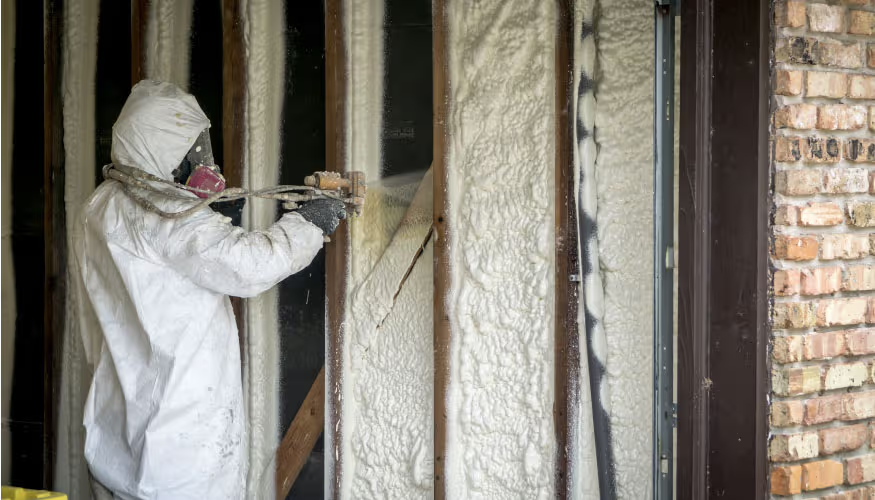
There’s a real process behind a proper basement liner installation, not just stapling plastic to a wall.
Most jobs wrap up in a day or two. Bigger basements, or ones with a lot of obstacles, can run a little longer.
We get the question about the basement liner versus paint, sealants and complete waterproofing often. Well, it depends on what you are suffering from. Waterproof paint can resist the surface water for a period of time after it’s applied, but if the water continues to be forced to penetrate the wall behind, the paint starts to bubble and peel.
A full basement waterproofing system, the kind with interior drains and a sump pump, is built for basements taking on standing water, not just dampness. A liner falls right in the middle of those two options. It stops vapor and humidity from soaking into the space, knocks out the musty smell, and leaves the basement looking clean and finished. For most of the basements we see across Connecticut and New York, a liner is the piece that’s actually missing.
After more than 25 years inspecting the basement, attic and crawlspace throughout Connecticut and New York. We have found that moisture issues don’t always occur themselves in the way that people think. Our crew inspects the whole space first and explains what’s going on before anyone touches a wall. Then we install a basement liner built to last, not a quick patch job.
We use durable, mold resistant material, seal every seam by hand, and stand behind the work, because we plan on still being in this business 25 years from now too. Call Eco Foam Insulation and you’ll get a straight answer, a fair estimate, and a crew that treats your basement like it actually matters.
A dry basement comes down to one thing: the right barrier between your home and the ground underneath it. If you’re done guessing and ready to fix the moisture problem, reach out to The Eco Foam Insulation for a free estimate. We will check the area, let you know what we see, and suggest the appropriate basement liner for your home. No push,no upsells, just good work.
The average life of a properly installed liner is 15 to 25 years depending on the thickness of material used and the original sealing of the seam.
Not on its own. A basement liner should be used to control moisture vapor and humidity, but is not suitable for controlling standing water. If your basement really does flood, use it in combination with a drainage system and sump pump to fully protect your basement.
Yes. Both terms describe the same product, heavy poly sheeting installed on foundation walls to block moisture and soil gas. Some people call it a moisture barrier too.
Plastic sheeting is available at any hardware store. However, when done in-house, this hole is usually not properly sealed at the seams, posts, and corners and it is this hole where moisture enters the home within a season or two years. There is no point in the seal not holding unless it is professionally installed.