Darien is one of those areas where insulation work rarely looks “bad” on installation day, but performance questions still show up later. Not always immediately. Sometimes, after a full season shift, or after HVAC cycles start revealing uneven load inside the home. Eco Foam Insulation approaches spray foam work in Darien from that angle, not as a material upgrade, but as something that interacts with how each house is already behaving before any foam is applied. There is a difference between filling cavities and actually changing how a structure responds. That difference becomes visible only after enough homes are seen under real operating conditions, not just during install.
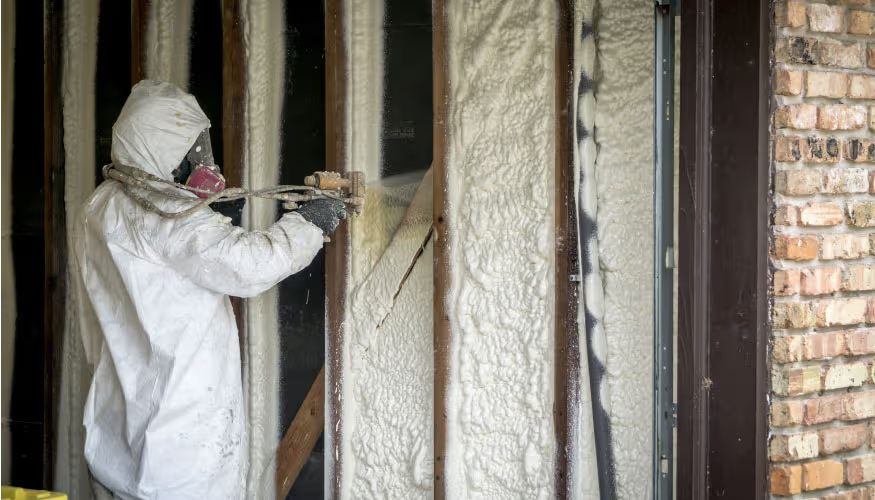
A common pattern in this area is not missing insulation. Most homes already have some form of insulation in place. What shows up more often is uneven performance across different zones of the same house.
One room holds the temperature longer than expected. Another responds quickly to outside changes. Attic spaces sometimes influence lower floors more than they should, even when insulation coverage appears complete.
These are not dramatic failures. They are small inconsistencies that become noticeable when the system runs over time.
Spray foam does not enter as a “fix everything” material in this context. It enters as a way to control how air movement behaves inside those structures.
In field work, spray foam is not treated as a uniform solution because it does not behave uniformly across all homes. In some houses, it tightens the envelope in a way that stabilizes temperature zones quickly. In others, results depend heavily on where movement inside the structure is already active. The same material can perform differently depending on how the house is already exchanging air through framing gaps, attic transitions, and wall cavities. This is why installation quality alone does not explain all outcomes. The condition of the structure before application matters as much.
Darien has a mix of older builds and upgraded homes, and both can show similar behavior patterns during insulation evaluation. Older homes often have long-established air movement paths that are not obvious during visual inspection. Newer homes may look tighter, but still show pressure imbalance between zones once HVAC systems run under load. When spray foam is introduced into either case, the response depends on how active those movement patterns are at the time of application. In stable conditions, results feel consistent. In unstable conditions, performance can feel uneven even when the application is technically correct.
The noticeable change is usually not immediate “comfort improvement” in a single direction. It shows up in how slowly or evenly the house reacts to external temperature shifts. Some homes reduce cycling variation after sealing. Others show better balance between zones that previously behaved independently. But this only becomes visible when air movement inside the structure is actually influenced. If the internal pattern is still active in multiple pathways, insulation alone does not fully redefine that behavior. That is why some homes feel a stronger shift than others after the same work.
From the outside, most Darien homes that receive spray foam look identical in terms of completion. Cavities are filled, coverage is consistent, and surface conditions appear clean. But field evaluation is not based on surface conditions. It is based on how the structure behaves after thermal load changes begin. This is where differences show up. Some homes settle into consistent response patterns. Others continue showing delayed or uneven behavior in specific zones. That difference is not visible at the installation stage. It becomes visible through the system response over time.
Work in Darien is handled with a focus on how the structure behaves before insulation is introduced, not only how it looks during installation.
Each home is evaluated based on airflow behavior, temperature response patterns, and how different areas of the house interact during system cycles. Spray foam is then applied based on those observed conditions, not as a fixed method applied the same way in every structure.
This reduces cases where insulation is present, but system behavior remains unchanged.
After working across many homes in this region, spray foam stops being viewed as a single outcome material. It becomes more like a response tool inside a larger system. Sometimes it stabilizes behavior quickly. Sometimes it needs supporting adjustments in how different zones are handled. Sometimes the structure itself shows limitations that cannot be corrected by insulation alone. That variability is not treated as failure. It is treated as structure-dependent behavior.
Because each structure has different internal air movement patterns and pressure behavior before insulation is applied.
Not always in a uniform way. The change depends on how the home was already behaving before installation.
Because insulation does not automatically reset internal airflow behavior across all zones.
Older homes often have more established airflow paths, which can influence how spray foam responds inside the structure.
How the house is currently reacting under normal HVAC and temperature conditions.